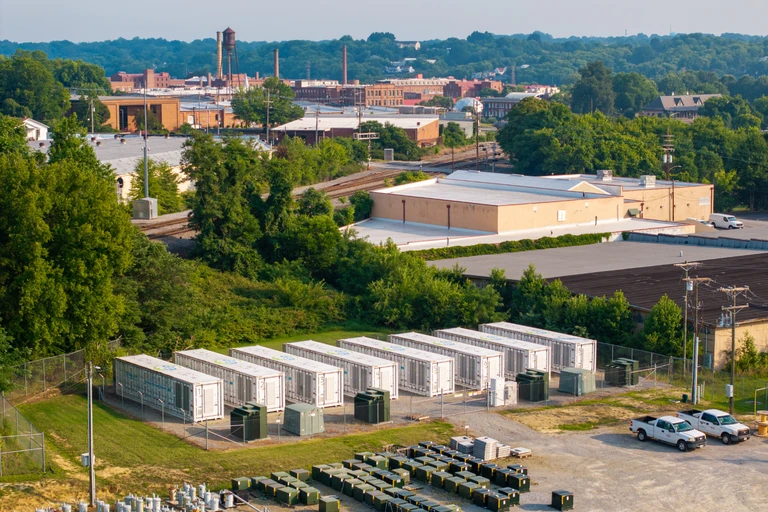
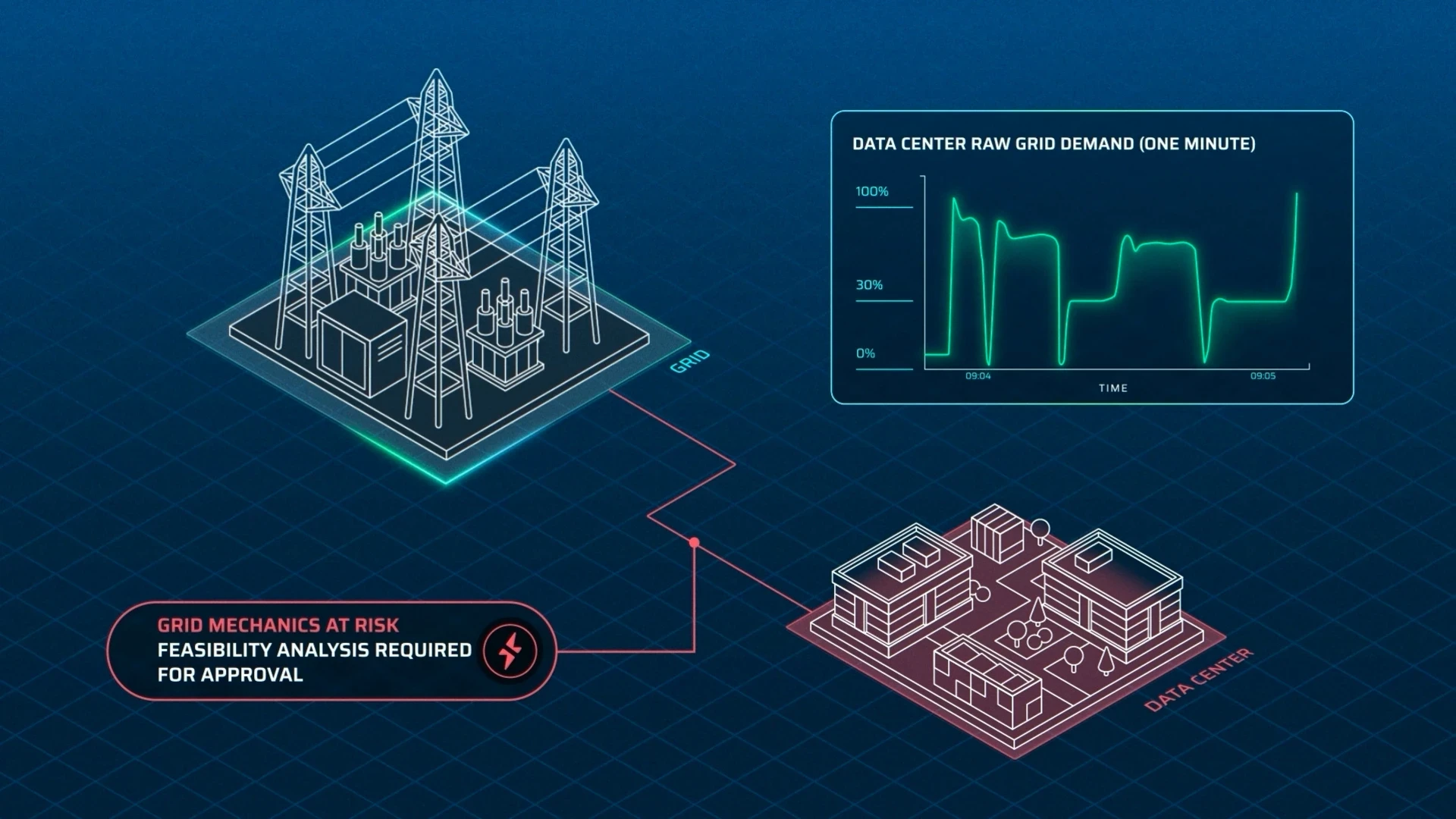
Time-to-power is the first, well-known hurdle developers face with any new AI data center project. The energy industry is tackling this from every angle to bring data centers online faster, from large-load interconnection reform to strategies like flexible interconnection paired with battery energy storage systems (BESS).
However, a data center’s power hurdles don’t end after a facility is energized. To ensure constant uptime, data center owners must quickly learn to maintain power quality through AI transient loads and coordinate complex portfolios of energy assets on site, such as natural gas generators, batteries, and solar.
Fortunately, managing transient loads and multi-asset orchestration are not new energy challenges. FlexGen has more than 15 years of experience deploying energy storage and microgrid solutions designed to manage rapid load fluctuations and coordinate multiple generation assets as a single, intelligent system. Now, we’re applying that experience, along with extensive testing in real-world conditions, to deliver comprehensive data center solutions.
Kyle Brezina, FlexGen's Software Engineering Director, explains why AI transient loads are not a new power challenge and how field-proven battery storage and microgrid control strategies help AI data centers operate reliably at scale.
Challenge: Maintaining power quality through AI transient loads
AI workloads are inherently transient because their training and inference processes cause power demand to ramp up or down in milliseconds. The rapid, unpredictable changes create transient loads that impact on-site power infrastructure and the larger grid. The magnitude of power swings increases with a data center’s size and workload.
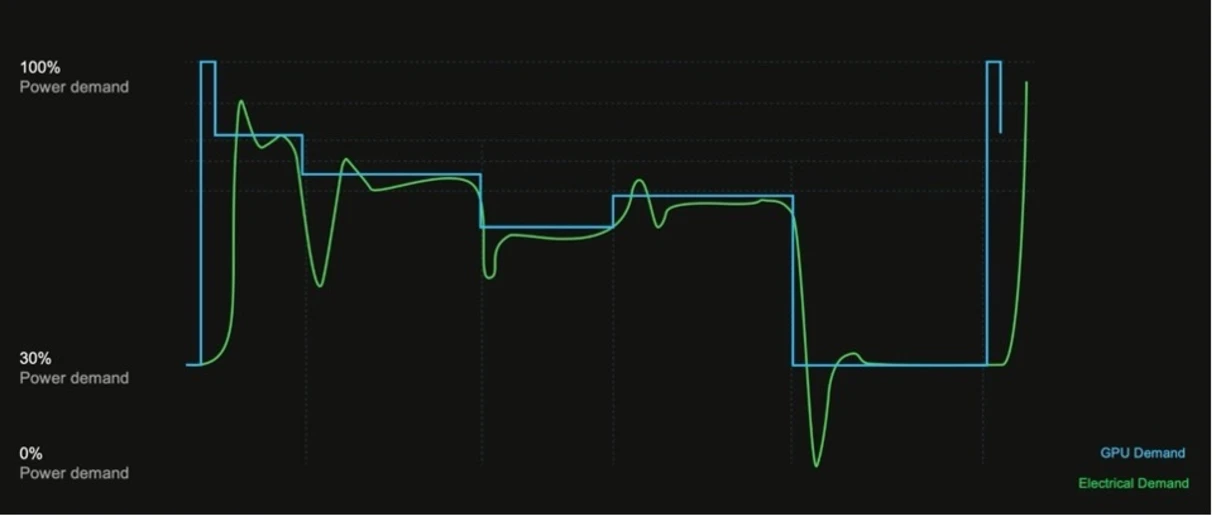
AI transient loads create rapid changes in GPU power demand, causing corresponding fluctuations in electrical demand. BESS and advanced controls help smooth these power swings to maintain power quality and reduce stress on grid and on-site infrastructure.
Large, rapid power swings are problematic for both utilities and data center operators. Sudden changes in demand can destabilize grid voltage and frequency. For data centers, fluctuating power demand adds undue stress to generation assets and sensitive computing infrastructure. Without local mitigation, data center operators may face longer interconnection timelines, higher infrastructure replacement and maintenance costs, and greater exposure to power quality events.
Solution: BESS as a load smoothing solution for AI data centers
Battery energy storage is an effective solution for maintaining power quality in AI data centers because batteries act as a buffer between AI loads and upstream power sources. When BESS is configured for load smoothing, it can significantly reduce the impact of rapid load fluctuations on the grid and on-site generation assets.
Large AI campuses (200 MW+) require two coordinated layers of control to effectively mitigate transient loads and maintain power quality:
Layer 1: Power Conversion System (PCS): The PCS responds directly to voltage, frequency, and current deviations caused by AI transient loads. Operating in milliseconds or less, a PCS provides the fast response required to manage power quality for AI transient loads.
Layer 2: Site Controller or Energy Management System (EMS): A site-level EMS, such as FlexGen's HybridOS, serves as the control layer. This software layer optimizes system-wide coordination and ensures the PCS aligns with site and grid requirements.
FlexGen supports varying levels of data center load smoothing based on site requirements, mitigating up to 99% of load fluctuations, depending on the BESS architecture. Smoothing power locally enables a more stable operating environment for AI workloads by improving power quality and reducing infrastructure stress.
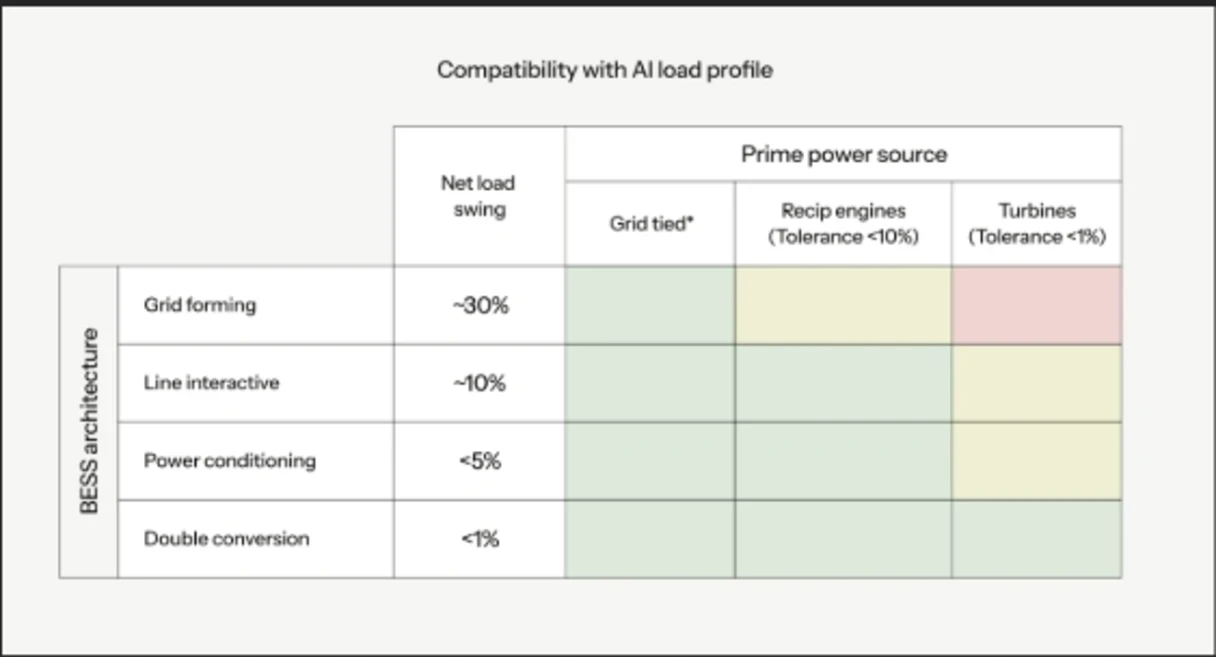
Summary of solutions to reduce the transient load swing experienced by a variety of power sources.
*The tolerance of the upstream grid depends on the weakest point of the local infrastructure.
Supporting low voltage ride-through (LVRT)
While AI transient loads originate within the data center, external grid events can also create power quality challenges that affect facility operations. If a large data center disconnects during a voltage disturbance, the sudden loss of load can create grid instability. Large load trips remove significant demand from the grid in seconds, making it more difficult for grid operators to maintain system balance.
During voltage disturbances, utilities may require large AI facilities to remain connected to the grid to “ride through” the event. BESS supports LVRT requirements by using stored energy to maintain power quality for downstream data equipment while upstream grid conditions recover. This allows sensitive computing infrastructure to continue operating through short-duration disturbances, so the facility can remain connected to the grid. LVRT capabilities keep data centers compliant with emerging standards by preventing disappearing large loads, protecting overall grid stability.
Challenge: Multi-asset energy orchestration
A diverse portfolio of energy assets is increasingly required to operate AI data centers, and each asset comes with its own operating constraints. Utilities impose interconnection rules. Generators have ramp-rate limitations. Data center servers require strict power quality performance.
Managing these requirements simultaneously requires sophisticated microgrid controls to coordinate thousands of operating signals in real time. Conflicts or lack of visibility between assets can lead to instability, inefficient dispatch decisions, higher operating costs, or unintended outages.
Solution: HybridOS supports multi-asset orchestration as a microgrid controller
FlexGen’s HybridOS continuously evaluates asset availability, operating limits, and site objectives, acting as the orchestration layer to coordinate multiple energy assets as a single system.
FlexGen has deployed HybridOS in complex microgrid environments across the U.S., including a Florida site where it dispatches BESS, solar, and traditional generator assets to mitigate frequent power quality degradation and allow for islanding and black start.
For AI data centers, HybridOS coordinates energy assets to maintain stable net power between the facility and the grid and ensure PCS-based load smoothing operates within generator and interconnection constraints.
HybridOS supports reliable operation by:
Prioritizing immediate power delivery during disturbances to maintain stable power quality for data center servers
Detecting grid disturbances, enabling seamless islanding, and coordinating grid resynchronization
Coordinating grid-forming or grid-following generators while optimizing the use of battery and renewable energy resources
Managing black start events and controlling inrush currents during equipment and transformer energization
Optimizing battery and generator dispatch to reduce peak demand charges and manage grid exposure
Enforcing utility interconnection requirements through ramp-rate controls and other operational safeguards
Coordinating fleets that utilize modern and legacy energy assets into a single system
HybridOS turns battery storage hardware into an adaptable foundation for operating large-scale AI data center power systems.
Building reliable AI data center power systems
Maintaining power quality amid AI transient loads and coordinating multiple energy assets are critical requirements for AI data center operation. BESS provides the necessary millisecond load smoothing for fluctuating AI workloads, while a sophisticated microgrid controller and EMS like HybridOS enables seamless multi-asset orchestration.
With deep experience in battery energy storage and microgrids, FlexGen helps data center developers and owners deploy reliable power systems that maintain power quality, protect infrastructure, and coordinate diverse energy assets at scale.
Download the Solving AI Transient Loads and Multi-Asset Orchestration White Paper for a deeper technical look at these challenges and the architectures used to solve them.