
Data Center Power Playbook: Multi-Asset Orchestration
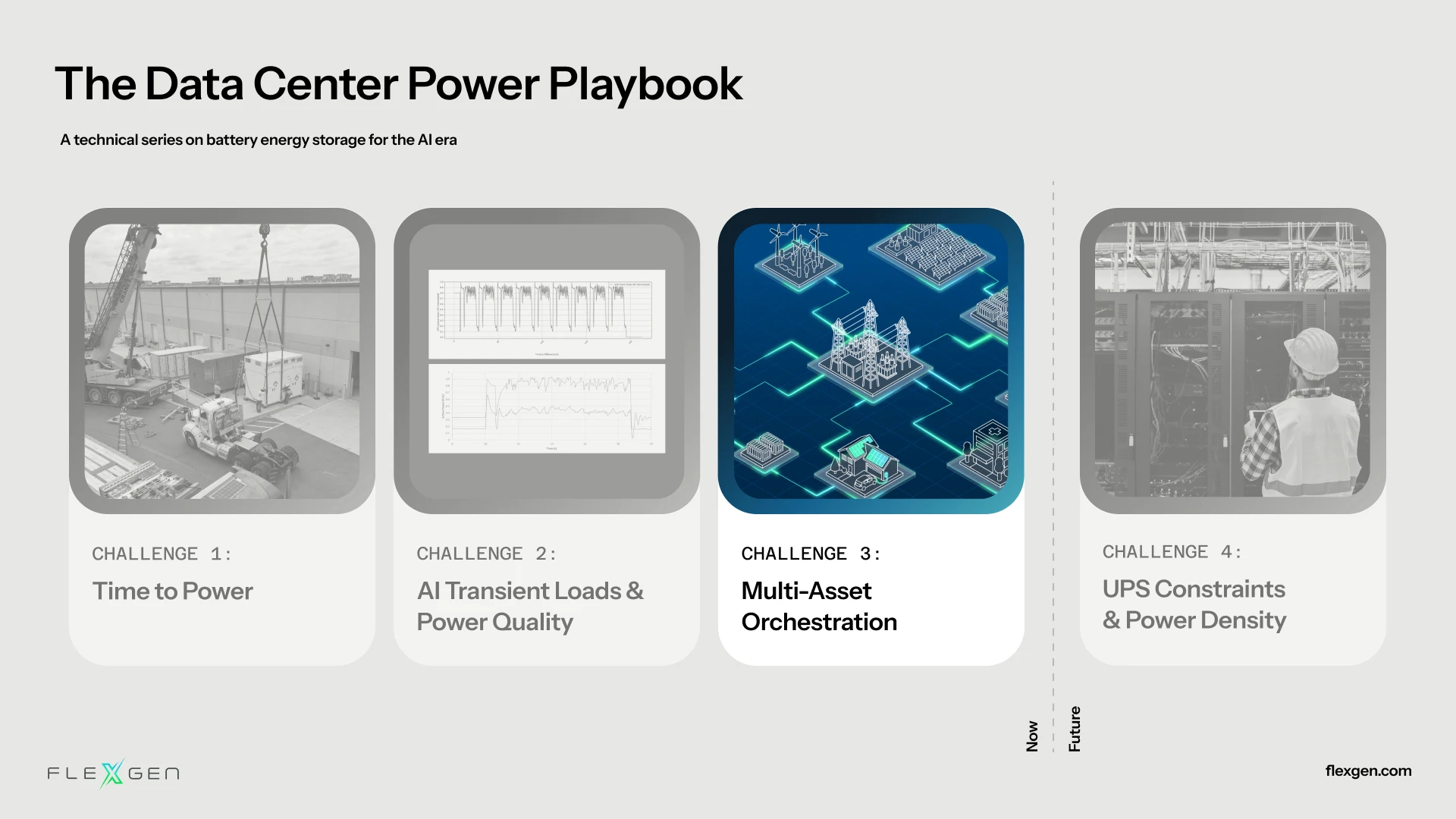
As AI data center campuses grow, many are adding on-site generation to improve reliability, work around or alongside constrained grid connections, and keep critical systems running through outages. This strategy creates a more complex power system, with battery storage, gas generators, utility power, and solar all needing to work together to serve fast-changing AI workloads.
Multi-asset energy orchestration is the real-time coordination of battery storage, generators, grid connections, renewable generation, and variable loads through a single control layer. Advanced energy management system (EMS) software provides this control layer, managing thousands of signals and operating conditions in real time, so multiple energy assets can operate as one system.
What you'll learn
As part of the Data Center Power Playbook series, this white paper focuses on Challenge 3: Multi-asset energy orchestration and its battery energy storage solutions. You’ll learn:
- Why AI data centers need real-time coordination across multiple power sources
- How battery storage and an advanced EMS create a single orchestration layer
- How microgrid controls support islanding, black start, generator coordination, and peak demand management
- How software can integrate a mix of power assets as campuses grow
- How FlexGen has applied these capabilities in complex, real-world power systems
How multi-asset energy orchestration works in AI data centers
At a data center site, every energy asset operates differently: generators have limits on how quickly they can respond to changing loads, batteries must operate within state-of-charge and thermal constraints, and utility interconnections come with strict operating and protection requirements.
Without coordinated control, interactions between these assets and rapidly changing data center loads can create instability or unintended outages during grid disturbances or transitions between grid-connected and islanded operation.
As data center campuses grow toward gigawatt scale, an advanced EMS can function as a site-level microgrid controller, providing the supervisory intelligence needed to coordinate batteries, generators, grid interconnections, and loads in real time.
Proven in complex power systems
For years, battery storage and advanced controls have coordinated complex energy systems across microgrids, utility-scale projects, and critical facilities. These systems have had to manage many of the same conditions now emerging in AI data centers: multiple power sources, constrained grids, islanded operation, and loads that cannot afford to go down.
FlexGen brings that experience to data center power. HybridOS, FlexGen's advanced EMS software, gives growing data center campuses a flexible control foundation that can evolve as their power needs and the market change.
Learn how battery storage and advanced EMS software can help orchestrate the next generation of data center power.