2025 tested the battery energy storage industry’s ability to execute amid volatility, while demand for reliable, flexible power continued to accelerate. Driven by data center power demand, maturing storage and energy management technologies, and expanding global battery markets, battery storage became a clear necessity in the evolving energy landscape.
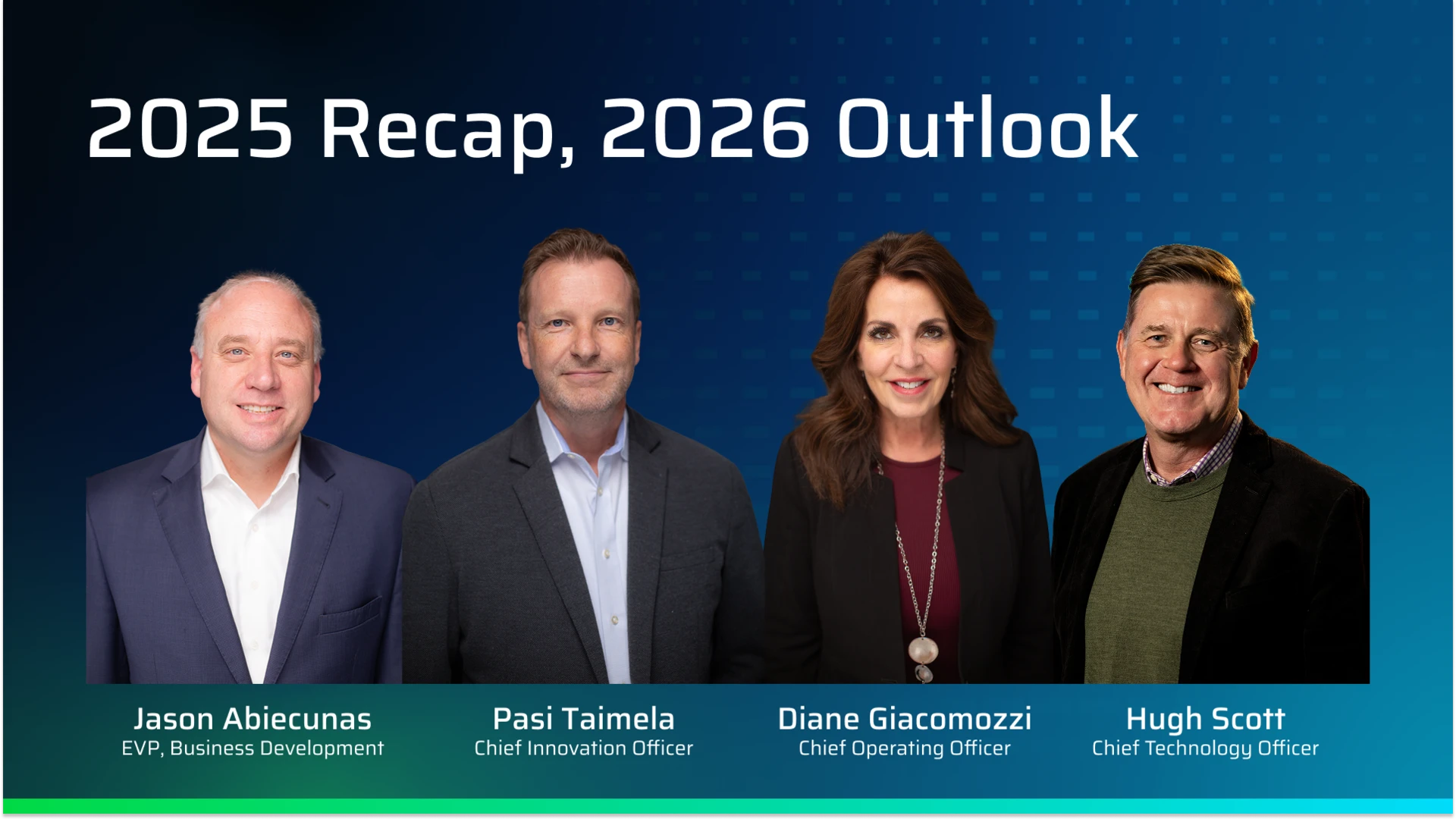
In this blog, FlexGen’s executive leaders reflect on the defining moments of 2025 and share their outlook for 2026. Drawing on perspectives across business development, innovation, technology, and operations, they examine how policy, supply chains, software, and emerging use cases are shaping the next phase of the battery energy storage market and where FlexGen sees opportunity ahead.
Executive takeaways
Jason Abiecunas – EVP, Business Development: In 2026, battery energy storage growth will be driven by policy clarity, accelerating data center power demand, and expansion across global battery markets, particularly in Europe.
Pasi Taimela – Chief Innovation Officer: Energy providers that can solve interconnection challenges and deliver technically qualified solutions will lead as data center power demand reshapes the energy landscape in 2026.
Diane Giacomozzi – Chief Operating Officer: In 2026, supply chain sophistication will determine which companies can compete and lead across global battery markets.
Hugh Scott – Chief Technology Officer: As grid constraints intensify in 2026, energy management software (EMS) will become the primary lever for maximizing battery energy storage performance and asset value.
Battery energy storage will see pivotal year driven by policy clarity, data centers and growth in Europe
Jason Abiecunas, EVP, Business Development, FlexGen
What changed in 2025
2025 was all about finding ways to execute in the face of uncertainty. Trade and tariff volatility created friction and delays, but power markets and development pipelines proved more resilient than predicted, reflecting both long-term demand fundamentals and flexibility across the value chain to keep projects moving forward despite geopolitical headwinds.
This year, we also saw the maturation of energy storage solutions for the data center market. We started talking about battery energy storage being a critical component of a modern data center design back in 2024. The industry has recognized the merits of this solution, as evidenced by NVIDIA’s white paper on next-generation data center architecture and by growing validation in our current projects integrating energy storage into data centers. We are excited about additional development and testing that we have ongoing in our lab and look forward to releasing those results in the coming weeks.
In 2025, FlexGen continued to deliver results for its customers, implement new projects, and move forward on strategic opportunities. We accomplished a major milestone in August when we closed the acquisition of key assets and intellectual property from Powin, meaning that FlexGen now supports over 25 GWh of battery energy storage globally. The initial priority was operational continuity for Powin customers. We have accomplished that, and we are now working on integrating HybridOS on the fleet to continue to improve operational performance.
Energy storage is growing globally to address growing power demand, intermittent resource integration, and integration of large loads like data centers. FlexGen is expanding our business in Europe to meet the market need for advanced EMS/PPC/SCADA solutions for energy storage and solar + storage applications. We have signed our first contracts to provide HybridOS software and services in Europe, and our team in Europe is actively engaging with the market to expand our presence and bring value to the European energy industry.
What to expect in 2026
The major themes to watch in 2026 are continued resilience of demand growth on the electric grid, data center infrastructure build-out, U.S. tax and trade policy, and continued evolution of the global supply chain. Energy storage has never been more critical to the challenges and opportunities for the power grid and critical digital infrastructure. The value delivered by FlexGen’s HybridOS software has never been greater as energy storage plants are being asked to do more, existing projects are being upgraded and retrofit to meet new needs, and new use cases require advanced controls.
It will also be a landmark year for data centers paired with advanced energy storage. We released a white paper detailing our technology and approach to integrating energy storage controlled by HybridOS with data centers and gas generation (engines and gas turbines). We will see advanced designs developed, equipment delivered, and energy storage keeping advanced AI model training and inference on-line and reliable.
Beyond the data centers, the need for reliable capacity and the unique ability of battery energy storage to balance the grid and moderate price variability will drive demand for energy storage globally. Our team is focused on delivering HybridOS to all battery energy storage and solar + storage applications globally while continuing to deliver exceptional service to the existing fleet of energy storage assets that we serve.
I am excited about 2026 and the opportunity we have to make a positive impact on power grids around the world, support the deployment of advanced data center infrastructure, and help our customers achieve their goals.
Energy providers will need deep technical understanding of data center challenges to lead the market
Pasi Taimela, Chief Innovation Officer, FlexGen
What changed in 2025
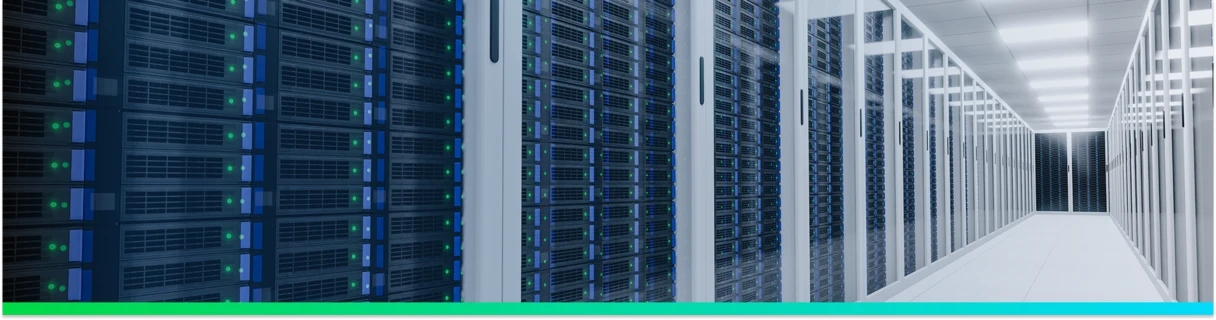
Last year, the data center industry, one that’s historically resistant to rapid change, became an early adopter, welcoming new solutions at unprecedented speed. We used to celebrate a 15 percent improvement in tech or solutions every five years, and now the industry is seeing 10x the scale-up at 10x the pace, driving innovation in all parts of the development cycle.
Faced with massive opportunity, data center developers and their strategic partners shifted timelines from multi-year cycles to quarterly decisions. Battery solutions providers were invited into the room early on, and customers demonstrated a willingness to adopt new solutions at a pace more consistent with software than infrastructure.
By moving early, partnering strategically, and proving execution, FlexGen has stood out as a leading data center solutions provider, further supported by our market-leading battery uptime, track record for deploying large-scale, front-of-the-meter battery systems, and ability to design for grid-side and load-side reliability. Additionally, our partnership with Rosendin generated real-world, grid-connected tests, showing progress toward a validated solution, giving developers confidence that FlexGen could fill a real gap in the market.
What to expect in 2026
In 2026, leading battery and energy providers will emerge based on their demonstrated capability to deliver a qualified solution to meet the unique energy needs of data centers. The industry’s hurdles will shift from speed-to-power to addressing the technicalities of interconnection with co-located battery energy storage, which will be established as a foundational component of every modern data center.
Additionally, we’ll move away from looking at data centers as monolithic. An increased focus on unique solutions qualified to meet data centers’ complex energy needs will result in more education around the various types of data center workloads, computing operations, and nuances that exist.
FlexGen’s hardware-agnostic approach and experience working across various types of projects allow us to make informed recommendations on what kind of hardware can meet each project’s specific needs. This will be crucial as focus will shift to the technical challenges that developers are facing when bringing data centers online, like improving ramp rates and designing hybrid power plants that can meet both the infrastructure and energy needs of data centers.
Supply chain sophistication will dictate industry leaders
Diane Giacomozzi, Chief Operating Officer, FlexGen
What changed in 2025
When I look back at 2025, what stands out most is the impact of sudden trade policy shifts and how close many projects came to being derailed as a result. The industry faced extreme volatility: shifting government legislation, sudden tariff increases, and ongoing compliance and geopolitical uncertainty. 2025 was a wake-up call for anyone who underestimated supply chain risk. Companies that relied on narrow sourcing strategies or purely transactional OEM relationships found themselves stuck, delayed, or priced out. What kept things moving for FlexGen’s projects was the depth of our relationships with OEMs and our ability to work creatively with them under pressure.
Because FlexGen has spent years building trust with multiple OEM partners, we were able to make fast decisions together, whether that meant accelerating shipments ahead of tariff increases or restructuring contracts to identify mutually beneficial ways to reduce tariff exposure. Those supply chain decisions directly preserved schedules, protected economics, and kept projects alive when the trade environment and broader unpredictability suggested they shouldn’t have been.
What to expect in 2026
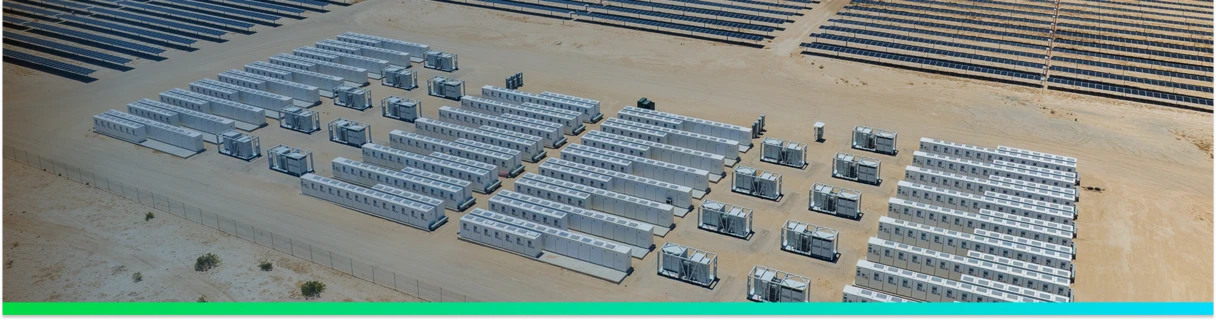
In 2026, supply chain sophistication will increasingly define winners and losers across the battery storage industry. As growth accelerates globally, particularly in Europe and other international markets, success will depend on understanding regional nuances: who leads the deal, how OEMs operate locally, and how value is created and captured across borders.
I also expect more global battery storage markets to demand turnkey solutions, often with OEMs taking a more dominant role than we’re used to in the U.S. That will require integrators to rethink how they partner, contract, and position themselves in the value chain. The companies that can seamlessly connect global manufacturing, regional execution, and local market needs will lead in 2026.
This year, global reach and influence will become even more central to FlexGen’s differentiation. We are no longer just managing procurement for U.S.-based projects; we’re actively positioning ourselves as a global partner to our OEMs, moving with them across markets and helping identify where opportunity exists next. As a result, our conversations are shifting beyond U.S.-centric execution to focus on how manufacturing, sourcing, and go-to-market strategies differ by region, and how FlexGen aligns with those strategies globally. This shift creates options, allowing us to adapt quickly as markets and policies evolve. In 2026, this global influence and strategic flexibility will be a key factor in what separates FlexGen in an increasingly complex energy landscape.
Energy management software will become the advantage for constrained grids
Hugh Scott, Chief Technology Officer, FlexGen
What changed in 2025
Last year, global demand for power continued to increase, creating a greater need for fast, dependable solutions. Battery energy storage emerged as the most immediate solution for adding capacity while also meeting the reliability requirements of large loads, such as AI-driven data centers. Battery uptime and performance became non-negotiable, further raising the importance of software controls that ensure assets are available and responsive when they matter most.
These evolving grid conditions and new large loads gave rise to more complex and flexible battery storage operations, where advanced software was critical to orchestrating various grid services and behind-the-meter load management needs. This complexity further elevated the importance of energy management systems (EMS) that can deliver reliable capacity, serve dynamic loads, and protect project economics.
At the same time, the exponential expansion of AI capabilities have allowed for faster execution of rapid software prototypes and reduced time from requirements to release, ultimately enabling EMS providers to deliver the features needed to manage complex and critical BESS needs.
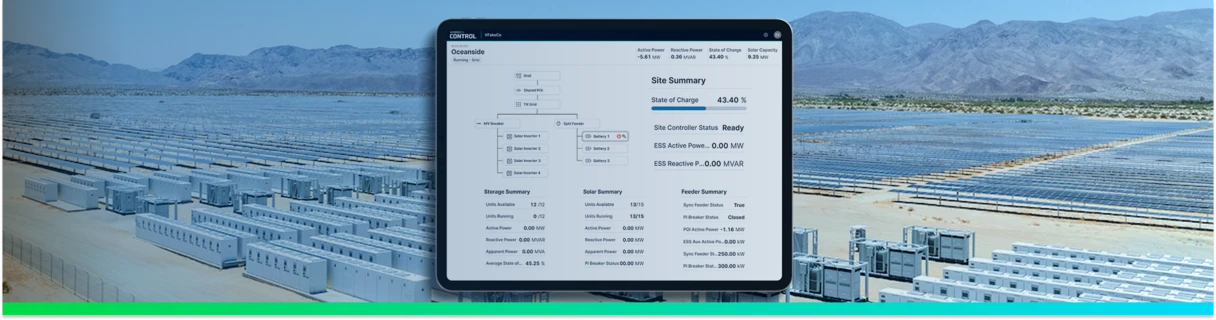
In 2025, FlexGen’s HybridOS™ energy management software continued to raise the bar for site performance, making batteries smarter, faster, and more reliable for owners and operators. HybridOS delivered industry-leading uptime with 98% availability, reflecting a focus on operational excellence at scale. New capabilities helped customers reduce risk and operating costs, from Predictive Analytics that identify hardware issues before they cause outages to the Power Flow Panel, which delivers clear, real-time visibility into site performance.
To support long-term planning and asset optimization, FlexGen introduced State of Health, leveraging real operational data to more accurately forecast battery degradation and augmentation timelines, along with Solar Power Plant Control (PPC) to unify hybrid asset management under a single control platform. As battery storage becomes increasingly central to grid reliability, advanced software like HybridOS is enabling higher-performance sites that maximize revenue while delivering dependable, flexible capacity to the grid.
What to expect in 2026
Looking ahead in 2026, growing grid constraints, interconnection backlogs, and rising demand will continue to put pressure on energy assets to do more. Utilities, independent power producers, and data center developers will need to increasingly rely on powerful software-controlled battery storage to unlock greater flexibility, resilience, and economic value from their portfolios.
Artificial intelligence will play a larger role in EMS platforms, proactively predicting issues, recommending corrective actions, and automating resolutions. Deeper integration of AI into analytics will further reduce downtime, optimize dispatch and performance, and expand revenue opportunities to improve site ROI. At the same time, battery software will evolve to support emerging use cases, including data center power reliability, blackstart and islanded operations, power quality optimization, and intermittent grid connections. These capabilities will be critical as battery energy storage takes on a more active and dynamic role both behind and in front of the meter.
A defining year for battery energy storage
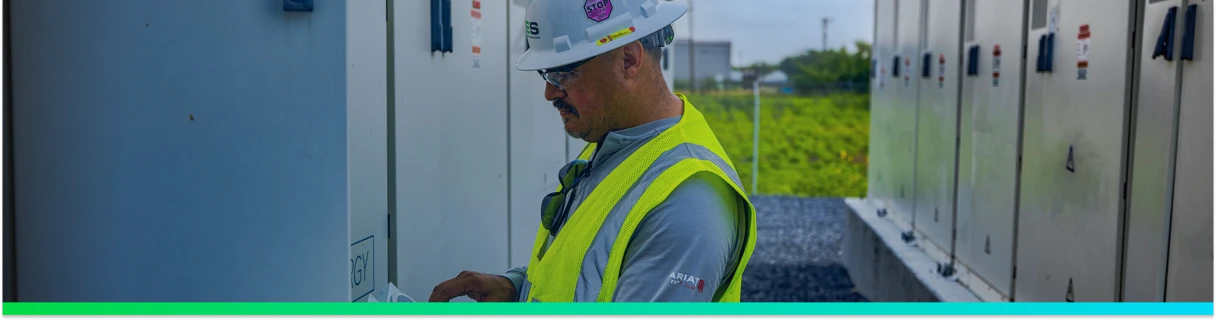
As we head into 2026, it’s clear that energy storage will be central to meeting load growth and maintaining grid reliability in increasingly constrained systems globally. The coming year will reward companies that can combine global reach with local execution, technical depth with speed, and hardware flexibility with intelligent software.
FlexGen is positioned for this moment. With the most knowledgeable team in the industry, expanded capabilities, strong global partnerships, and a proven ability to deliver under pressure, we are focused on helping customers navigate complexity while scaling battery energy storage to meet the demands of tomorrow’s energy landscape.