Data center load growth is straining MISO grid reliability
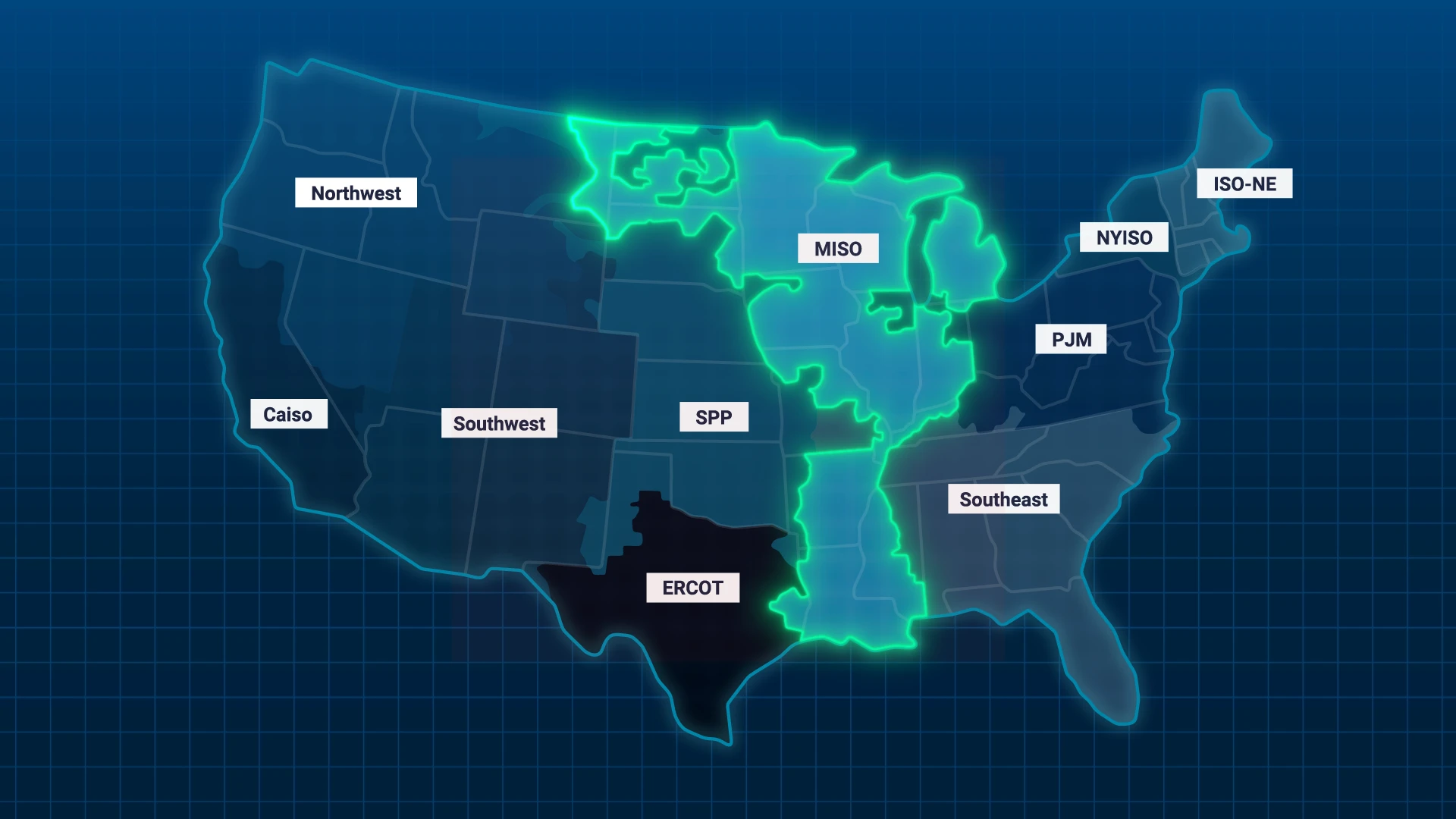
The Midcontinent Independent System Operator (MISO) is the electric grid operator for the central United States and Canadian province of Manitoba. Data center demand in MISO is growing faster than new supply can come online, forcing utilities and grid operators to confront capacity constraints in real time. Operating one of the largest and most complex grids in North America, spanning from the Gulf Coast to Canada and coordinating thousands of interconnection points and generation units, MISO must balance supply and demand across a highly distributed system under increasing strain. The ISO is operating with tight supply margins, and longer-term reliability depends heavily on projects that are not yet online.
In 2025, MISO planned to retire roughly 2.3 GW of generation, including major coal assets that will be replaced with gas-fired and renewable power. RTO Insider reports that slower-than-expected capacity additions could push MISO into a 14 GW deficit by summer 2029. That risk reflects a system relying on future supply that may not arrive on time. New generation projects require years to permit and construct, and interconnection queues stretch over multiple years, slowing the pace of new supply even further.
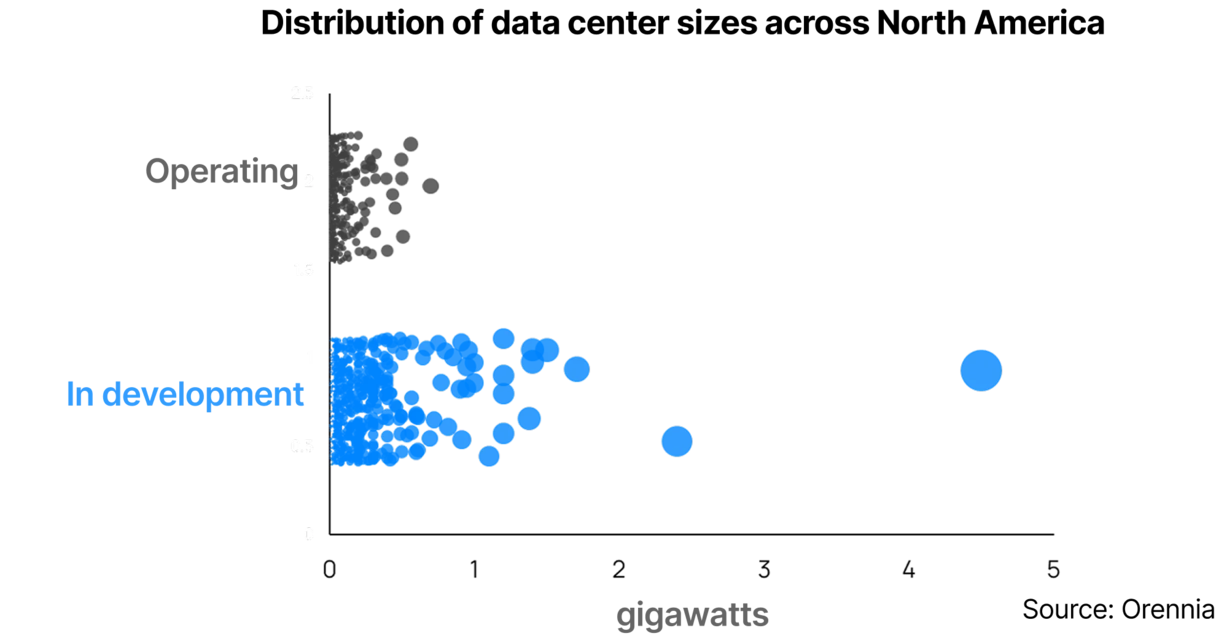
Data visualization showing the power requirements of existing data centers compared to those in development in North America. Source: Orennia
Demand is growing at the same time, driven largely by data center expansion in MISO. The FERC State of the Markets Report 2025 shows average data center size increasing from 25 MW in 2020 to nearly 80 MW in 2025, with MISO experiencing a 43% compound annual growth rate — the fastest among U.S. markets.
Forecasts point to sustained pressure in the region:
8-14 GW of new data center load expected in 2026-2027
Peak demand rising 35%, up to 163 GW by 2035
Data centers accounting for approximately one-fifth of MISO electricity consumption by 2030
To address these supply and demand challenges quickly, MISO is beginning to lean into battery energy storage systems (BESS) as a fast-to-deploy tool that strengthens grid integrity and resource adequacy while longer-lead generation is developed. FlexGen is supporting this momentum across the region, helping bring storage online and ensuring it performs reliably under the ISO’s evolving needs and requirements.
Time to Market for Energy Resources
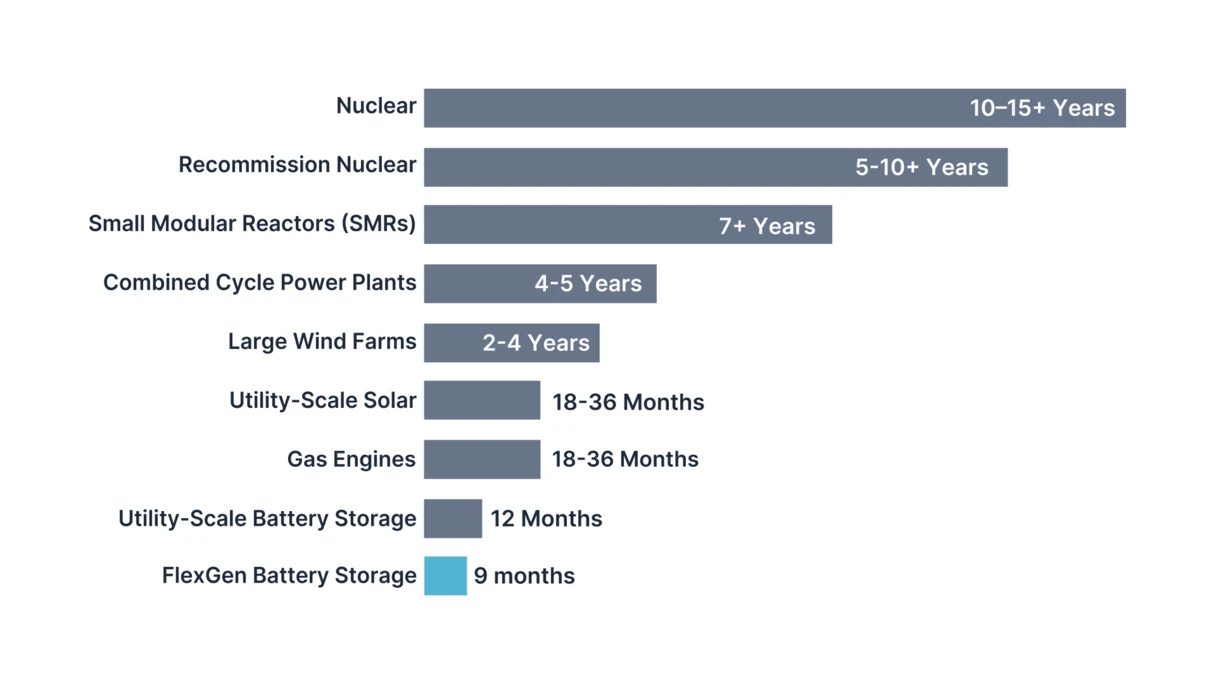
Graph visualizing time to market for different energy resources. (Estimates based on industry reports, project case studies, and regulatory framework.)
BESS is a fast, scalable solution to MISO’s near-term capacity needs
Battery storage projects can reach operation in under a year, giving utilities and developers a way to add capacity on a much shorter timeline than traditional generation. In MISO, storage deployment is accelerating quickly. MISO’s operational battery energy storage capacity grew by 366% in 2025 alone, from 176 MW to 784 MW, and another 49 GW of storage is in its interconnection queue.
Market dynamics in MISO place strong emphasis on reliability services, so energy storage resources primarily support system integrity through:
Voltage control and frequency response to stabilize grid conditions
Load smoothing to reduce rapid demand swings
System balancing to maintain real-time alignment between supply and demand
In parts of the MISO footprint, particularly in wind-heavy regions like Iowa, generation is frequently curtailed or even priced negatively due to transmission constraints. In these cases, battery storage enables operators to capture otherwise unused energy and redeploy it when demand and prices rise.
FlexGen's role in delivering MISO battery storage
Flexgen currently supports more than 450 MW of operational battery storage in MISO, roughly half of the region’s installed capacity, and has an additional 400 MW in development. Our footprint spans the full project lifecycle, from design and construction to long-term operations, including large-scale deployments like the 700 MWh portfolio developed in partnership with Alliant Energy across Wisconsin and Iowa.
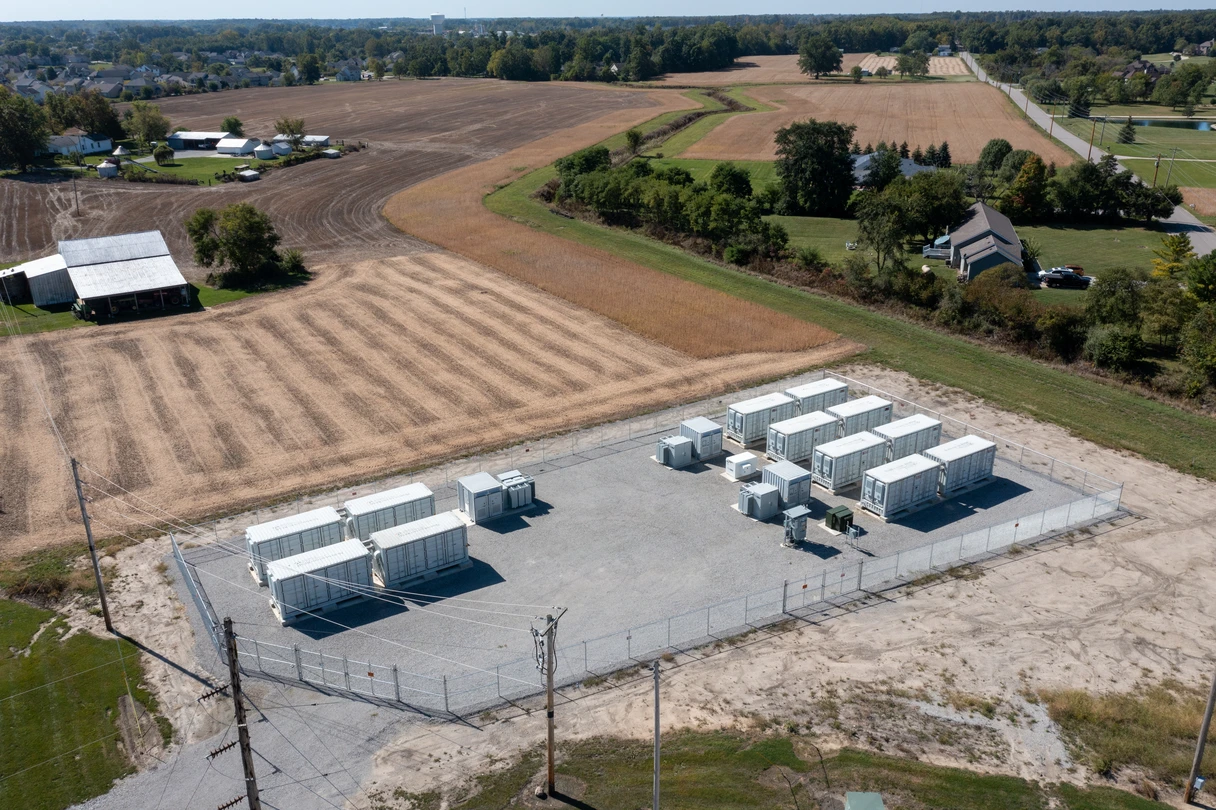
A FlexGen-supported Northeastern Rural Electric Membership Corporation (NREMC) battery storage site in Perry, Indiana.
Executing projects in MISO requires deep expertise in both market dynamics and battery system performance. Generation Interconnection Agreement (GIA) requirements continue to evolve throughout the development lifecycle, requiring teams to adapt system designs in real time to maintain compliance as new standards emerge.
FlexGen supports both standalone and hybrid storage projects paired with solar and wind, leveraging a hardware-agnostic approach that allows flexible system design across multiple vendors. Our team stays ahead of regulatory change through active participation in industry working groups and technical forums, allowing us to anticipate emerging requirements rather than react to them.
Once projects are operational, HybridOS, FlexGen's energy management system (EMS), orchestrates real-time grid interaction. Purpose-built to meet MISO’s stringent interconnection standards, HybridOS software adjusts system cycle timing with sub-millisecond precision, ensuring seamless grid integration while maintaining stability under dynamic grid conditions.
Lessons from CAISO and ERCOT on scaling battery storage in MISO
While storage deployment is gaining momentum in MISO, market structures and operational frameworks are still evolving. Continued progress will depend on clearer ancillary service participation rules, more efficient interconnection processes, and defined standards for integrating advanced capabilities, like grid-forming.
CAISO and ERCOT, two battery-experienced markets, have already addressed these challenges, offering a clear reference point for how battery storage can scale effectively.
Grid capacity and resource adequacy
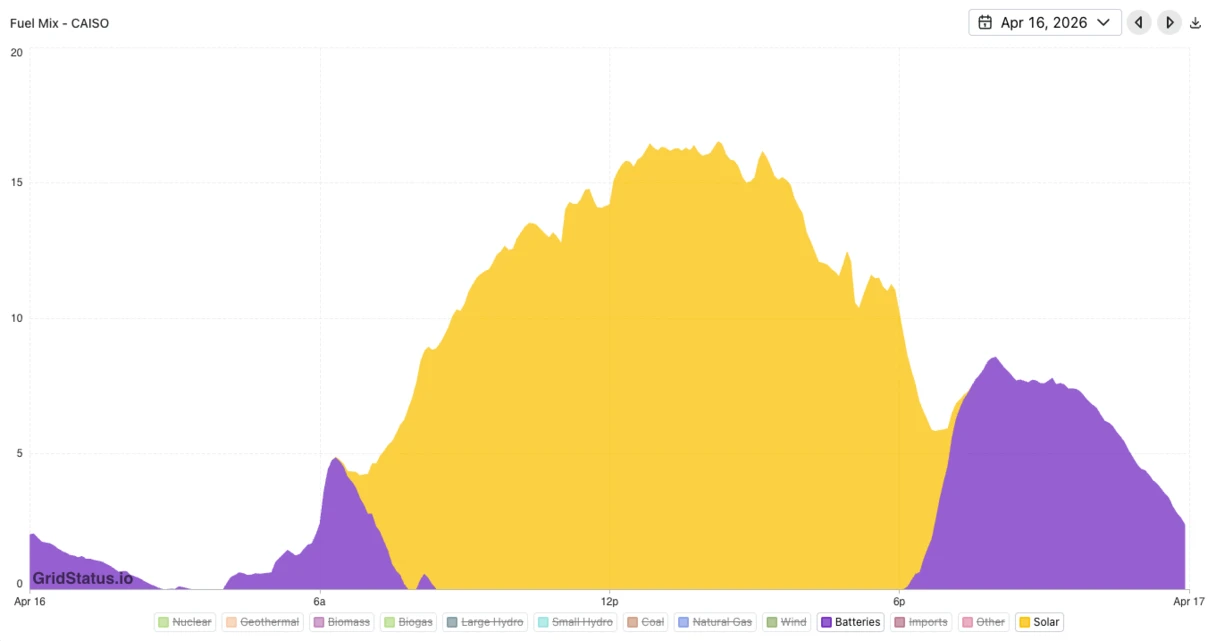
As renewable penetration increases, grids experience greater swings in net load, commonly referred to as the “duck curve.” CAISO and ERCOT rely on batteries as dispatchable capacity to absorb excess renewable generation during periods of oversupply and discharge during peak evening demand as solar generation declines and renewable output fluctuates. The same operating pattern is increasingly relevant in MISO, where rising peak demand intersects with one of the nation’s largest wind generation markets. In markets with a critical mass of intermittent generation sources, storage helps maintain grid reliability and balance supply.
Solar and Storage Fuel Mix - CAISO
Solar and Storage Fuel Mix - MISO
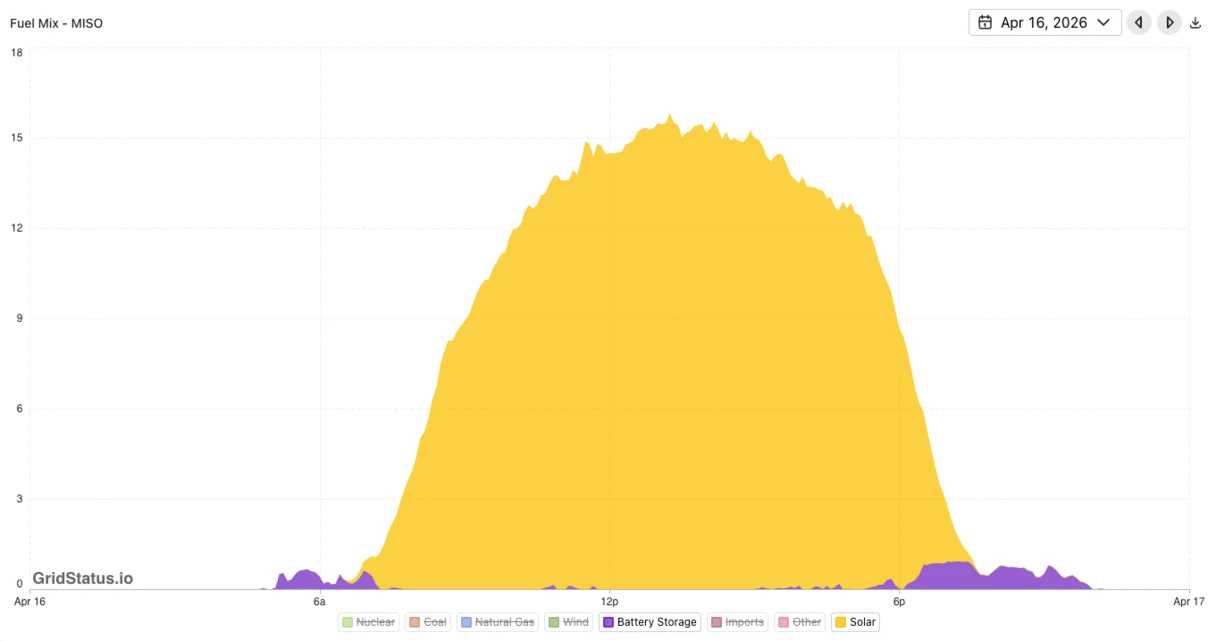
Charts generated by GridStatus.io show the difference in daily battery storage use on April 16, 2026 between the established CAISO BESS market and emerging MISO BESS market.
Reliability under increasing data center load
Managing large, volatile AI data center loads requires fast-response resources to maintain system balance. Software-controlled batteries respond within milliseconds, stabilizing frequency and voltage as conditions change. In CAISO, batteries provided 84% of regulation up and down services in 2024, demonstrating their central role in maintaining grid stability. The 2025 grid collapse in Spain and Portugal also underscored the importance of fast-response balancing and stabilization capabilities as power systems manage increasingly complex operating conditions.
Affordability and pricing stability
Battery storage reduces reliance on high-cost peaking generation. According to Utility Dive, adding 11 GW of storage in MISO could save $27 billion in system costs by 2035 and reduce wholesale power price growth by $1.40/MWh.
PJM is approaching the same storage inflection point as MISO
The pressures building in MISO are not isolated. The same combination of accelerating data center load and long development timelines for new supply is taking shape in PJM.
PJM projects a potential generation shortfall of up to 49 GW by 2028 if load continues to outpace new supply.
In both MISO and PJM, storage can add capacity on an expedited timeline. An energy storage outlook for PJM found 16 GW of storage will be needed to serve anticipated load growth in the region by 2032, growing to 23 GW by 2040.
Solar and Storage Fuel Mix - PJM
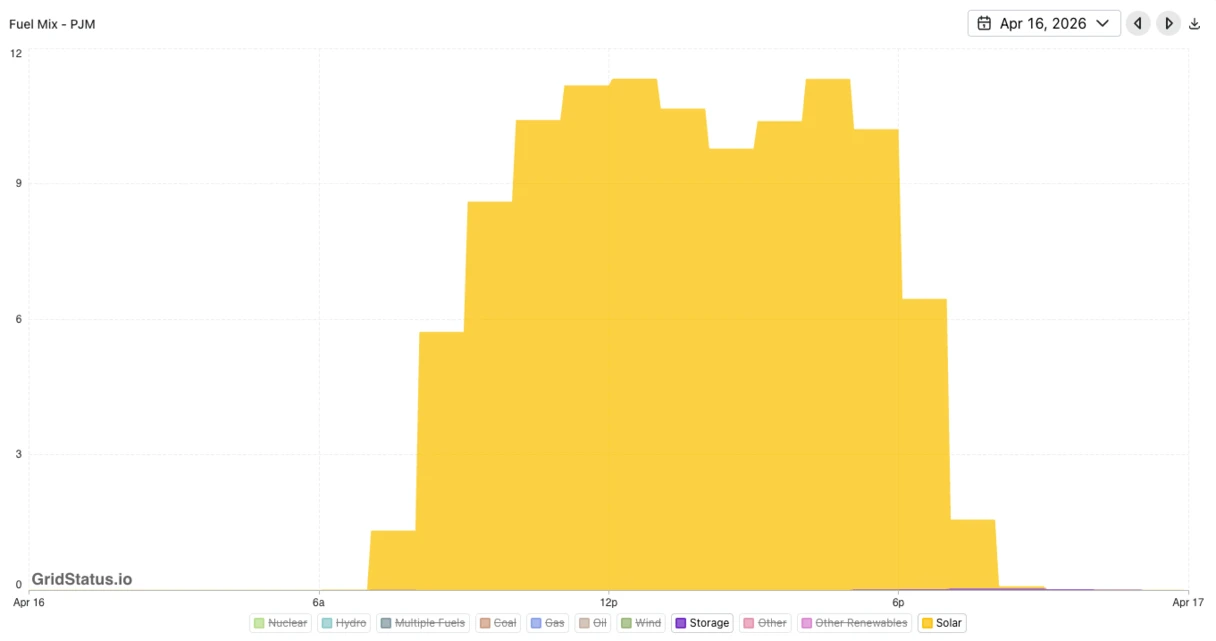
A chart generated by GridStatus.io shows limited daily battery storage use on April 16, 2026 in the PJM market.
Current battery deployment in PJM remains limited. The ISO has 415 MW of installed storage, representing a small fraction of future requirements. Meeting projected demand will require a 40-50x increase in deployment over the next decade.
Policy updates are beginning to support that growth projection. In 2025, PJM:
Updated surplus interconnection rules, enabling new resources to use existing grid connections and unlocking up to 26 GW of additional capacity
Expanded its frequency regulation market, increasing procurement from 320 MW to 750 MW, creating additional opportunities for battery participation
PJM is also emphasizing load flexibility from large energy users as grid reliability pressures grow, including recent emergency measures allowing curtailment of certain data center loads during periods of system stress. Co-located batteries can help address both sides of the equation by giving utilities fast-response demand flexibility while helping data centers maintain operational continuity through seamless backup power support and reduced reliance on diesel generators.
These developments reflect the same evolution seen in MISO as energy storage began scaling across the market. Like CAISO, ERCOT, and MISO, PJM is positioning BESS as a critical resource for meeting growing power demand while maintaining system reliability. FlexGen is already leveraging lessons learned from MISO, CAISO, and ERCOT to support the next wave of projects in PJM.
Scaling battery storage in MISO and beyond
Closing the capacity gap and maintaining grid integrity in MISO and PJM will come down to battery storage execution, including how quickly storage can be deployed and integrated. FlexGen brings direct experience from established battery markets in CAISO and ERCOT, along with deep, hands-on expertise in MISO and PJM to help projects move through interconnection, meet evolving requirements, and operate reliably once online. Contact us to get started.