

ERCOT’s Real-Time Co-Optimization plus Batteries (RTC+B) significantly changed how battery energy storage resources participate in energy and ancillary services markets. The RTC+B program reshapes dispatch logic, ancillary services participation, and real-time optimization, affecting Energy Storage Resources (ESRs) across the ERCOT system.
FlexGen recently supported the RTC+B market cutover by enabling customer-owned battery assets operating on HybridOS, FlexGen’s energy management system (EMS) and power plant controller (PPC), to transition to the new market structure. The successful cutover took place following months of preparation and rapid adaptation by FlexGen teams to evolving requirements during one of ERCOT’s most complex market transitions to date.
Tony Olivo, SVP, Software Engineering at FlexGen, discusses how HybridOS software contributed to the successful navigation of ERCOT’s RTC+B cutover.
What is RTC+B in ERCOT?
RTC+B fundamentally changed how ERCOT dispatches and optimizes battery resources. Under the new framework, real-time energy dispatch and ancillary services are co-optimized simultaneously, rather than through separate, sequential processes. This approach better reflects the physical capabilities of inverter-based resources and improves system-wide efficiency and reliability.
For ERCOT, RTC+B enables:
More efficient real-time dispatch across energy and ancillary services
Improved alignment between dispatch signals and physical system behavior
Enhanced scarcity pricing and reliability outcomes
For battery storage systems operating in ERCOT, RTC+B introduced a unified participation model, including:
Transition from separate Generation Resource (GR) and Controllable Load Resource (CLR) models to a single ESR model
Replacement of Updated Desired Basepoint (UDBP) with Updated Desired Setpoint (UDSP), consolidating dispatch into a single operating signal
Support for an extended Primary Frequency Response (PFR) operating range, consistent with the unified ESR model \
Deprecation of the FRRS product, simplifying ancillary services participation
A reworked ancillary services award structure, requiring tighter coordination between real-time dispatch, ancillary service obligations, and physical system limits
The simplified system still required careful implementation and validation as market behavior, settlement logic, and ERCOT guidance evolved throughout the transition.
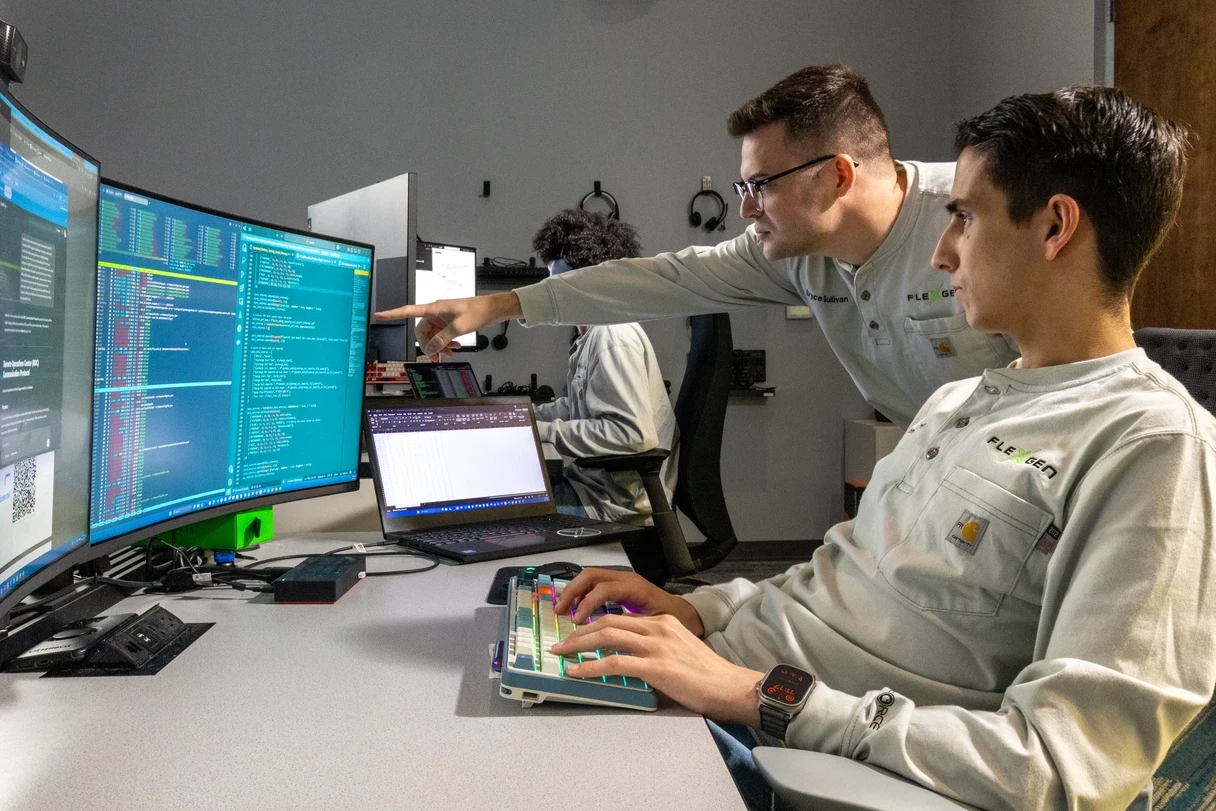
FlexGen experts in our Remote Operating Center monitor customer battery storage sites 24/7 to ensure operational reliability.
How HybridOS Supported the RTC+B Cutover
Preparation for RTC+B began in February 2025. Even with foundational planning, system design, and HybridOS capability development established in advance, several critical implementations ultimately compressed into week-level timelines as new ERCOT requirements and customer needs emerged.
In the weeks surrounding the December 5, 2025 cutover, FlexGen teams supported customers through multiple parallel workstreams while ERCOT requirements continued to change right up to, and even after, go-live. This required close coordination across software engineering, market operations support, and customer-facing teams to ensure HybridOS-enabled assets were ready to operate under the new model.
FlexGen teams enabled RTC+B readiness across a diverse fleet of customer-owned battery energy storage assets operating on HybridOS, including:
Upgrades across a multi-site utility-scale and merchant storage portfolio
Concurrent support for multiple HybridOS major release versions operating during the transition
Enablement of RTC+B across varied system architectures and control configurations
Validation across a wide range of site scales, hardware combinations, and integration models
In total, FlexGen supported 36 sites, more than 800 MW of capacity, three HybridOS major releases, and integration with three different qualified scheduling entities (QSEs) during the RTC+B cutover.
Enabling High-Performance Frequency Response and RRS Positioning
HybridOS continued to support Fast Frequency Response (FFR) and its stringent performance requirements in parallel with RTC+B readiness. As ERCOT increasingly relies on inverter-based resources for system reliability, high-speed frequency response has become a key differentiator for storage assets participating in ancillary services markets.
By enabling consistent FFR performance, HybridOS allows customer assets to meet ERCOT’s high-performance requirements, supporting preferred positioning within the Responsive Reserve Service (RRS) award structure. This positioning places qualifying assets first in line for high-value RRS deployment events when system conditions require rapid response.
Achieving this level of performance requires capabilities that are increasingly important under ERCOT’s co-optimized market design: precise control, fast telemetry, and tight integration between market signals, site-level controls, and physical system behavior.
Supporting RTC+B Execution Beyond Go-Live
FlexGen teams continued to provide ongoing operational and market support beyond the early December cutover. Teams were available through the holiday period, including Christmas Day, to assist customers and QSE partners as the new market design stabilized.
This sustained support helped customer assets participate in ERCOT markets with minimal disruptions during the high-risk RTC+B transition period, preserving operational reliability and revenue continuity.
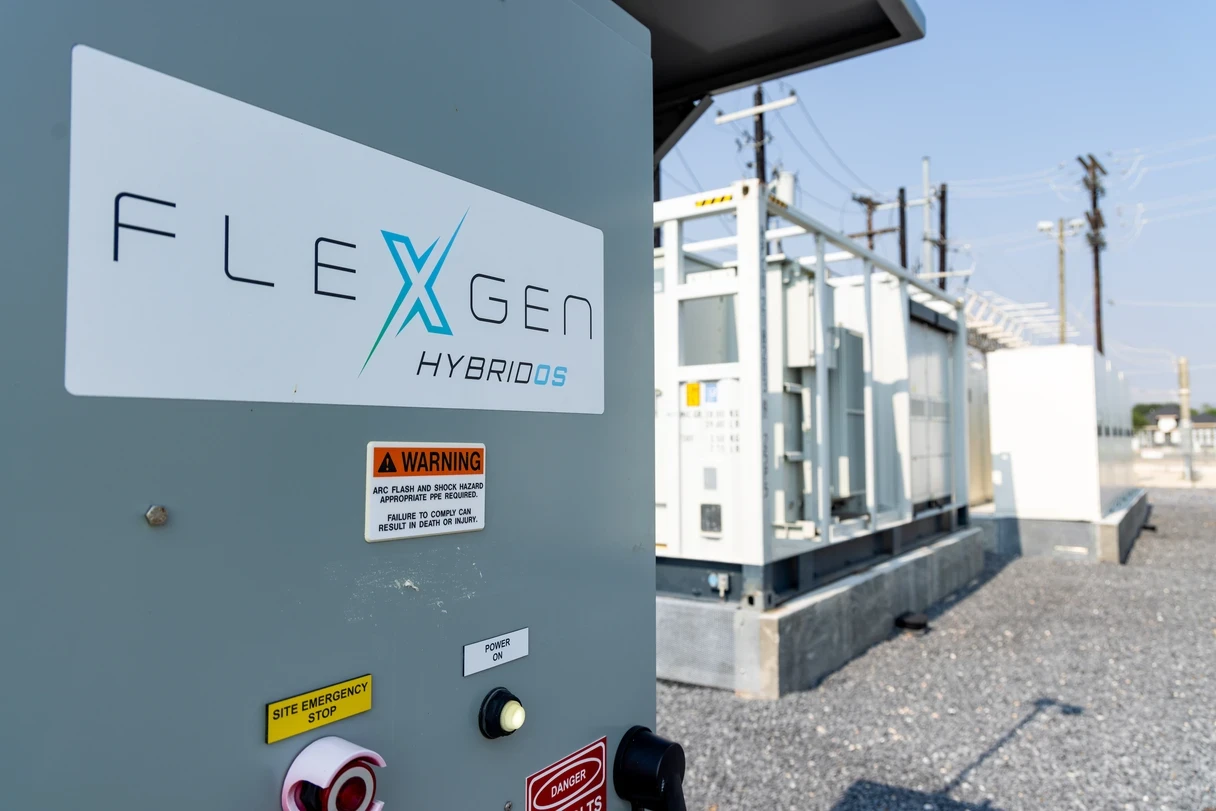
A battery energy storage system supported by FlexGen’s HybridOS software.
Delivering Real Customer Value
RTC+B restructured ERCOT’s market design, directly impacting how battery assets are dispatched, awarded ancillary services, and settled. In addition to software updates, successfully navigating this transition required coordination, operational discipline, and an EMS capable of adapting to rapid change.
RTC+B cutover support delivered tangible value to FlexGen customers by:
Enabling continued participation in ERCOT markets with minimal disruptions
Ensuring compliance with new RTC+B market requirements
Preserving access to high-value ancillary services, including preferred RRS positioning through strong FFR performance
Protecting revenue during a complex market transition
Before implementing an EMS such as HybridOS, engineers needed to individually upgrade each project, almost to the point of recommission. The RTC+B transition demonstrates the value of an EMS and PPC platform designed to update remotely and operate reliably under changing market rules and increasing grid complexity.
Preparing for Future Market Changes
RTC+B will not be the last major energy market evolution. As grid conditions, resource mixes, and reliability needs continue to change, market rules will develop alongside them.
In this environment, a responsive, adaptable EMS is essential to maintain compliance. A sophisticated EMS also maximizes market availability, supports high-performance ancillary services, and enables customers to capture value as new products and dispatch logic emerge. The successful RTC+B cutover in ERCOT reinforces the importance of EMS platforms that can evolve in lockstep with market design.
The RTC+B transition underscores FlexGen’s role in enabling customers to navigate market change and operate confidently when it matters most.